The first time I argued hard for a design and won, I was proud of myself for about a week. Then it reached production, and the failure I had waved away in the review was exactly the thing that broke. I had not made a technical mistake. I had made a human one. I had fallen in love with my own idea, and I had been persuasive enough to take everyone else down with me.
As architects, our decisions ripple across teams, systems, and sometimes whole businesses. The discipline that protects all of them fits in four words: decide on merit, not momentum.
- The bias you most need to fear is not a stakeholder's. It is your own, and it is invisible to you by design.
- The model in five moves: pause, invite friction, demand evidence, write it down, revisit.
- What it costs you, what it builds in you, and why your whole team starts deciding better once you do.

The Bias You Cannot See Is Your Own
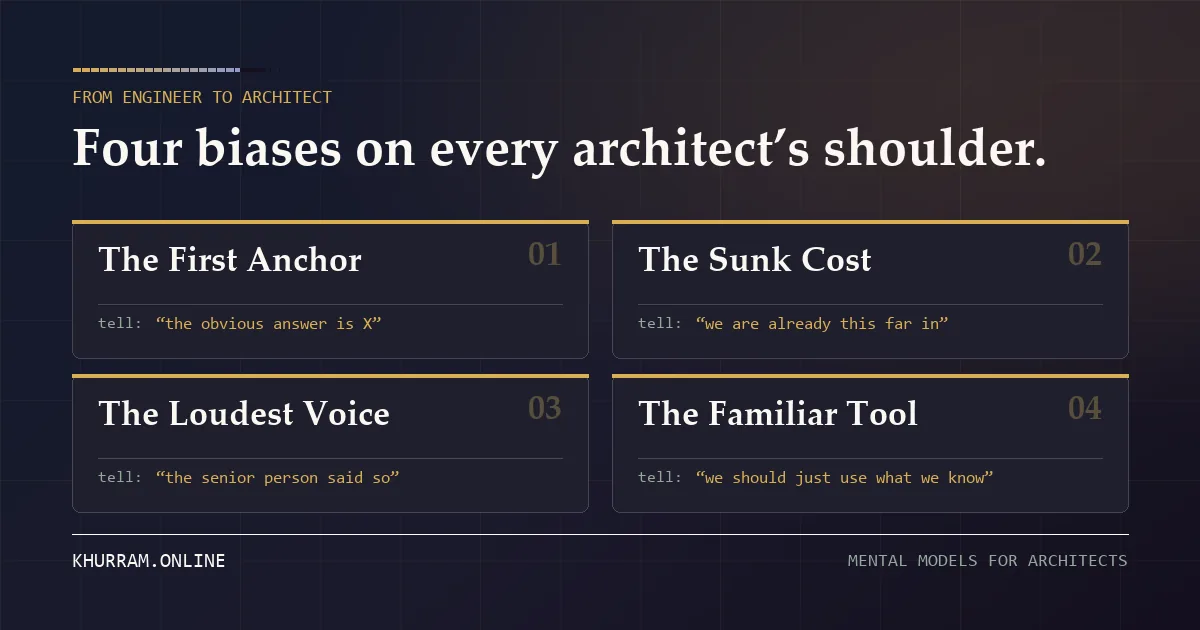
Even the most experienced minds fall into the trap of cognitive bias. Anchoring to the very first idea that sounded viable. Doubling down on a failing path because of everything already sunk into it. Favouring the loudest voice in the room over the quietest, more correct one. It happens constantly, to all of us, and in architecture it is genuinely dangerous, because our mistakes do not stay local. They ship.
Every architect learns to watch for other people's bias. The vendor who only sells one kind of answer. The team that wants the technology that looks good on a CV. The manager who decided in the corridor and now wants you to bless it. We get good at spotting those, because they happen in front of us, where we can see them.
The bias that does the real damage is the one you bring into the room yourself. It does not feel like bias. It feels like experience. It feels like taste. It feels like knowing, from twenty years of doing this, what the right answer is before anyone has finished describing the problem. That quiet confidence that you already know is the single most expensive thing an architect can carry into a decision.
I do not say this from above the problem. I say it because I have been the problem. I have reached for the database I am fluent in when the use case quietly wanted a different one. I have defended an architecture longer than the evidence deserved, because I drew it, and walking it back in public felt like admitting something about me rather than about the design. The bias was never sitting across the table. It was sitting in my chair.
None of these are stupidity. Every one of them is a smart person's shortcut that hardened into a habit. That is what makes them dangerous. They are made of the same material as good judgment, and from the inside they are almost impossible to tell apart.
Decide on Merit, Not Momentum
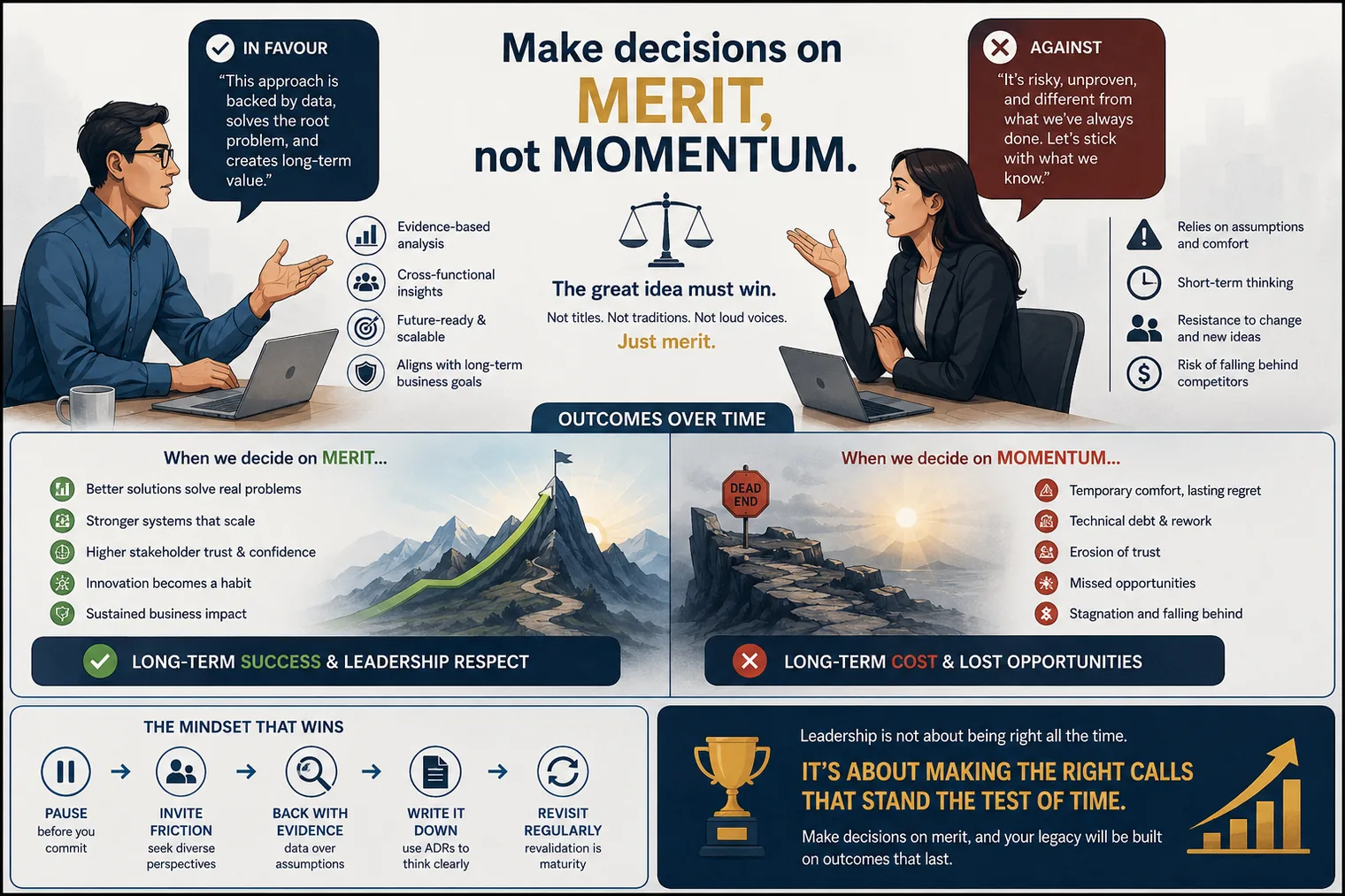
This is the mental model that changed how I lead and decide, and it fits in four words: make decisions on merit, not momentum. Momentum is everything pulling you toward a choice for reasons that have nothing to do with whether it is right. Familiarity. The first idea. The loudest voice. The hours already sunk. The way it has always been done. Merit is the opposite shortlist: the data, the fit to the actual scenario, the evidence, the honest trade-off. The whole discipline is learning to feel the difference between the two, in the moment, before you commit.
The most useful thing I have learned here is about order. Decide what matters before you look at the options, not after. If you choose your criteria after the candidates are on the table, you will, without noticing, weight the one dimension your preferred answer happens to win on. Define the scoring first, while you are still honest, and the decision stops being a referendum on your taste.
Write the criteria before you write the shortlist
Name what actually matters for this scenario, in this order, before any option is on the page: the load you must carry, the failure you cannot afford, the team that has to run it at two in the morning, the cost you have to defend. Then let the options meet the criteria. When my own preferred answer loses on a sheet I wrote before I knew it would lose, I have learned to trust the sheet over the feeling. That sheet is the architect taking their own thumb off the scale.
How to Build This Model
A mental model is only real if it survives contact with an ordinary Tuesday. It is not a poster on the wall, it is something you do, repeatedly, until it becomes part of your belief and value system. Here is how I build this one into the daily work, in five moves.
-
1
Pause before you commit
Before you commit, ask one honest question: are you leaning toward this because it is familiar and easy, or because it is genuinely right? The pause is short. The bias it catches is not.
-
2
Invite friction
Actively seek diverse opinions, cross-discipline views, and a named devil's advocate. A decision nobody pushed on is a decision nobody pressure-tested. Conflict, handled with respect, sharpens clarity.
-
3
Back it with evidence
Support the call with benchmarks, prior incidents, and trade-off analysis. Not assumptions, and not resemblance to the last thing that happened to work. Evidence is what lets the best idea win without you in the room.
-
4
Write it down
An Architecture Decision Record is not paperwork. It is a reflection tool, and a trap you set for your own future bias. Six months on, when pride and sunk cost are whispering that you were always right, the record remembers what you actually weighed.
-
5
Revisit your decisions
Not everything ages well. The load changes, the constraints move, the assumption expires. Going back to revalidate a decision is maturity, not weakness. The architects I trust most are the ones who reopen their own calls.
Watch one phrase especially closely as you do this: the best technology. There is no such thing. There is only the best fit for a particular load, a particular team, a particular set of constraints, at a particular moment. The word best, used without a scenario attached, is almost always a bias with a respectable hat on. The discipline is not to reject what you know. It is to make what you know earn its place against the scenario, every single time, the same way a new option would have to.
Convince With Data, Not Ego
Taking yourself out of the decision is only half the work. The other half happens after you have formed a genuine, evidence-led view and now have to bring a room with you. Here the temptation flips. Having done the honest analysis, it is tempting to skip showing it and simply assert the conclusion, especially once you are senior enough that people will go along with it. That is ego wearing the costume of efficiency, and it quietly rots trust.
The architects I have trusted most did the opposite. They made their reasoning impossible to misread. They showed the options they rejected and why. They stated the pros and the cons of the path they recommended, including the cons, out loud, before anyone had to drag them out. They named the risks they would rather not mention, the ways their own recommendation could still be wrong. Naming the weakness in your own proposal is what makes people believe the strengths.
The decision that wins because of who said it
When a choice carries the day because of the seniority of the person who made it rather than the weight of the evidence behind it, you have not won an argument. You have postponed one. The team executes without conviction, the quiet doubts go unspoken, and the flaw nobody felt safe enough to raise surfaces later at the worst possible time. A recommendation that cannot survive its own pros and cons being shown was never strong enough to ship.
There is a test I use on myself. If I removed my name and title from the recommendation, would it still win on the page alone? If the answer is yes, I have done my job. If the answer is no, then what I am relying on is authority, and authority is a loan against trust that always comes due.
What This Builds in You
Deciding on merit does more than improve the choice. Practised over time, it builds the character an architect actually runs on, the traits that make people trust you with bigger decisions.
And perhaps the most important effect is the one you do not have to do anything extra to get. It trains your team and your stakeholders to do the same. When people watch you pause, invite the friction, follow the evidence, and change your mind in public without flinching, they learn that it is safe to do it too. The discipline stops being a thing you carry alone and becomes the way the room decides.
In architecture, opinions are loud, but outcomes are louder. The great idea has to win. Not the loudest voice. Not the title. Not the tradition. Just merit.

If the first discipline is removing yourself from the decision, the next is widening what you can see before you make it. Article 2 turns to perspective over perception: 360 degree detail orientation, and why what you see is so rarely the whole truth.