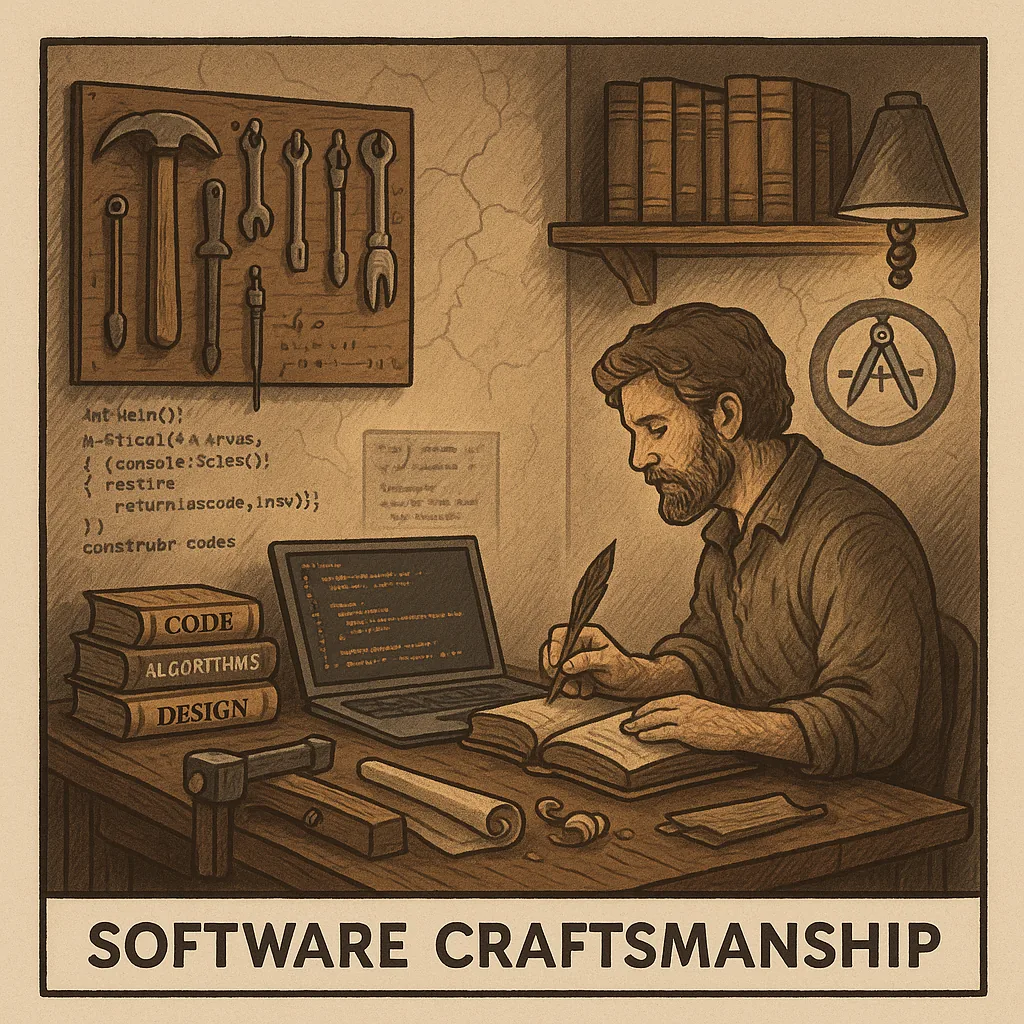
There are two ways to approach professional life. You can treat your work as a job – something that fills your days, pays your bills, and gives you a sense of stability. Or you can treat it as a craft – an ongoing pursuit of mastery, meaning, and contribution. A craft is not performed; it is lived.
For me, work – whether architecture, engineering, leadership, teaching, or writing – is not an obligation. It is a craft. This understanding did not arrive suddenly. It matured through years of moving across countries, industries, projects, and cultures: from Pakistan to Japan, and from Japan to Germany – and through all of it, one thing became clear: craftsmanship is not something you learn. It is something you live.
Pakistan: Foundations of Grit and Ownership
Growing up in Pakistan, my love for books shaped the earliest version of who I am. Stories became my teachers, and learning became a lifelong habit. As a proud alumnus of Hamdard University (Batch 8, MCS 2000–2002), I received an internship offer at a Job Fair even before finishing my degree.
After my internship, I began teaching Java at a university. I quickly realised that technical skill matters, but connecting with human struggles matters even more. Students understood me not because I was an expert, but because I remembered how difficult it felt to be a beginner. That awareness – the memory of struggle – would later shape my leadership philosophy across three countries.
Early in my career at a global payments company, I worked on mission-critical payment systems where even a small oversight could affect thousands of users. This environment taught me real ownership: responsible for outcomes, not just tasks. I learned to think about systems in layers – load, throughput, latency, failure modes, operational risks, and user impact.
Japan: Where Excellence Becomes a Lifestyle
Japan changed everything. I often say: if you want to learn technology, read books. If you want to learn discipline, go to Japan. Whether it's the precision of trains, the harmony in architecture, the consistency of service, or the fireworks that take decades to perfect – Japan embodies the philosophy of craft.
At a Japanese e-commerce giant, I led the team that redesigned the next-generation search engine – supporting multilingual queries, contextual tagging, morphological analysis, and massive scale. Our performance goal was 100 milliseconds per query. We achieved it. But what stayed with me was not the metric; it was the discipline, teamwork, and culture that made it possible.
We practised Test-Driven Development rigorously, achieving 99% code coverage and reducing defects to near-zero. I learned a powerful truth: mastery requires consistency, and consistency requires humility. You cannot become a craftsman if ego blocks improvement.
Later, at a global clothing brand, I led teams across Japan, China, and India to build Cart & Checkout systems serving millions of users globally. What Japan taught me – more than technology – was a philosophy:
If there is no possibility, create one. If there is no paradigm, invent one. If there is no tool, build one.
Germany: Precision, Regulation & Architecture at Scale
Germany brought refinement – and a form of complexity I had not confronted in quite the same way before. Here, the challenge was not just scale or speed. It was designing systems that could be trusted: compliant under GDPR and DORA, resilient under regulatory scrutiny, and maintainable by engineers who would inherit them long after the original architects had moved on.
This constraint – which initially felt like friction – became its own form of craft discipline. I learned that a system which merely works is not finished. A well-crafted system works in a way that can be explained, audited, and defended – not just today, but in five years. Regulatory compliance, properly understood, is accountability engineered into the architecture.
Germany also sharpened my understanding of where technical problems actually originate. I once reduced cloud infrastructure costs by 70% – not through cleverness alone, but by creating an environment where engineers felt safe enough to question assumptions, surface inefficiencies, and propose unpopular simplifications. The waste had always been visible. What was missing was the culture that made pointing it out safe. Cost problems are almost never purely technical. They are culture problems that appear on the infrastructure bill.
From these years emerged what has become my analytical signature: evaluating every architecture through four non-functional pillars – Throughput (TPS, QPS, RPS), Load, Scale, and Capacity. Not as a checklist, but as a craftsman's lens. A solution that cannot answer these four questions is not yet a solution. It is a prototype wearing production clothes.
Three countries. Three forms of the same discipline. What emerged was not a checklist but a way of working: collaborate without ego, own the outcome and not merely the task, treat every "impossible" as a problem that has not yet met the right mindset, and put people before the technology every single time. I have set those principles down in full on a separate page – but the important thing about them is not the list. It is where they came from. Not a book. The work itself.
The Journey Continues
After more than two decades across three countries, I still consider myself a student. Not because I know less, but because mastery never ends. Craft is a journey with no final chapter.
Every new challenge is a chance to refine, rethink, rebuild, and reimagine. Every day is a chance to improve something – code, architecture, culture, processes, or myself.
Take your work as a craft, and you will build more than systems. You will build possibilities. You will build people. You will build yourself.