For the last few weeks my feed has been full of people turning themselves into Studio Ghibli characters: the soft light, the round faces, the impossible skies. Watching the trend, I felt the pull to do something a little different. Not to make a Ghibli version of myself, but to tell you where my own Ghibli story actually began, almost twenty-five years ago, in a small movie store that no longer exists.
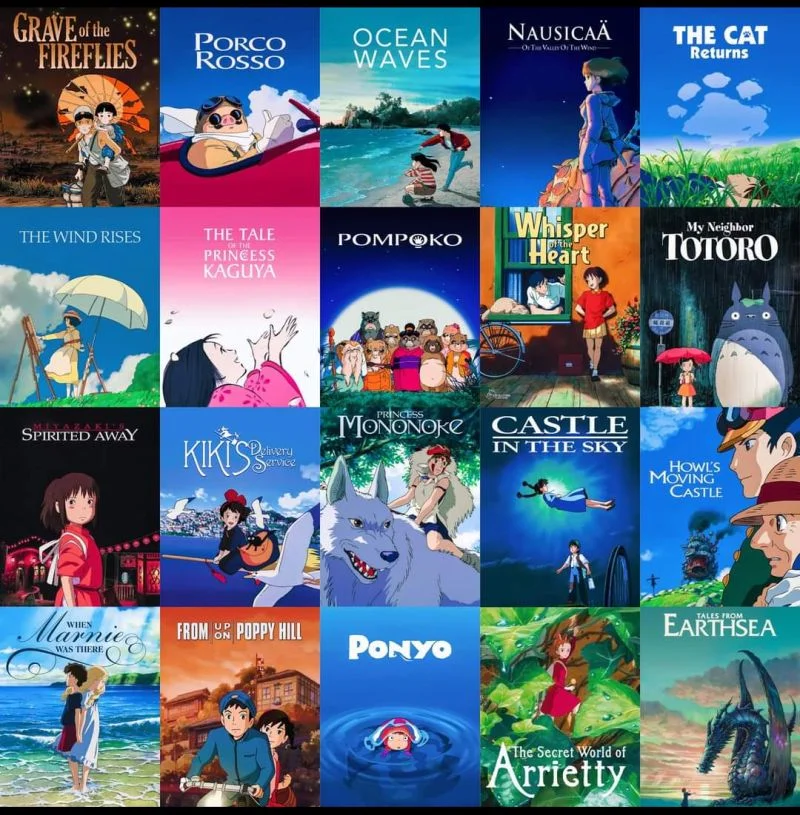
All film posters and artwork © Studio Ghibli, shared here in tribute and courtesy of Studio Ghibli.
The Movie Store
In the early 2000s I picked up a habit that quietly shaped the rest of my life. I started collecting films. Once a month I would walk into the same little shop and leave with my quota, fifteen or twenty titles on VHS, CD, or DVD, chosen as much by the owner as by me. He was not really a shopkeeper. He was a walking encyclopedia of cinema, a genuine film obsessive with an unerring instinct for the masterpiece you did not yet know you needed. I have written before about the things from that era that stayed with me, and that shop is high on the list.
It was him, not an algorithm, who handed me my first Ghibli film: Princess Mononoke. I went home, watched it, and something quietly rearranged itself. The artistry. The refusal to make the villains simple. Worlds that felt older and stranger than anything I had seen drawn before. From that evening on I was, permanently, a fan of Hayao Miyazaki and of Studio Ghibli, and every month after, my mentor made sure there was something extraordinary waiting in the stack.
What Makes It Ghibli
What set Ghibli apart, I only worked out later. There are rarely pure villains in these films; the people you arrive ready to hate turn out to have reasons, and the story makes you sit with that. Nature is a character, not a backdrop. Someone is almost always flying. And Miyazaki is unafraid to simply stop, to let a kettle come to the boil or the wind move through a field of grass, trusting you to feel the weight of an ordinary moment rather than rushing you to the next event. After years of action films the same shopkeeper had been feeding me, this was a different language entirely, and once I had learned to hear it, I could not unhear it.
Passing It On
Years later, when my three sons came along, I knew exactly what I wanted to hand down. Not a lecture about good taste, just the films themselves, watched together, the way I had first met them. Ghibli became part of their childhood the way it had become part of mine, and somewhere along the line my private obsession turned into a family tradition. We are, all of us, die-hard fans now. We have worked through a great many films in this house, and nothing still casts the spell that Ghibli does.
The collection itself kept growing, eventually into the thousands, but Ghibli always kept its own shelf in my head. My sons arrived into a house where Totoro was already part of the furniture, and they took to it the way children take to weather, as simply how the world is. We argue about the ranking now, which is its own quiet joy. The list further down is firmly mine; each of them would fight for a different order, and that is exactly as it should be.
There is a kind of teaching that happens without a single instruction, just by sharing something you love until it quietly becomes theirs too. I have come to believe that is the most durable kind. And it is not lost on me that the country which made these films is one I would later live in. By the time I moved to Tokyo, Ghibli had already taught me how to see Japan: patient, detailed, unhurried, finding the sacred in ordinary things. The films came first. The country only confirmed them.
My Top Ten
Choosing ten is unfair to the rest, but these are the films I return to, and the ones I would start a newcomer on:
- Spirited Away. A surreal masterpiece on identity, resilience, and greed; a girl must work in a bathhouse for spirits to win back her parents and her way home.
- Princess Mononoke. The one that started it for me. A warrior caught between humans and the forest, trying to hold a balance that may not be possible.
- My Neighbour Totoro. Two sisters and a gentle forest spirit; the purest distillation of childhood wonder Ghibli ever made.
- Howl's Moving Castle. A young woman under a curse finds love and adventure inside a wizard's restless, walking home.
- Grave of the Fireflies. Isao Takahata's devastating story of two orphaned siblings trying to survive the last months of the war. You watch it once.
- Kiki's Delivery Service. A young witch starts a flying delivery business and learns, gently, what independence actually costs.
- The Tale of the Princess Kaguya. Takahata again; a hand-drawn folktale of a moon princess that looks like nothing else in animation.
- Porco Rosso. A pilot cursed with the face of a pig duels air pirates over the Adriatic while carrying an old, unspoken grief.
- Castle in the Sky. Two children and a sky full of danger, chasing a legendary floating city.
- The Secret World of Arrietty. A tiny borrower and a human boy, and the quiet ache of two worlds that cannot quite meet.