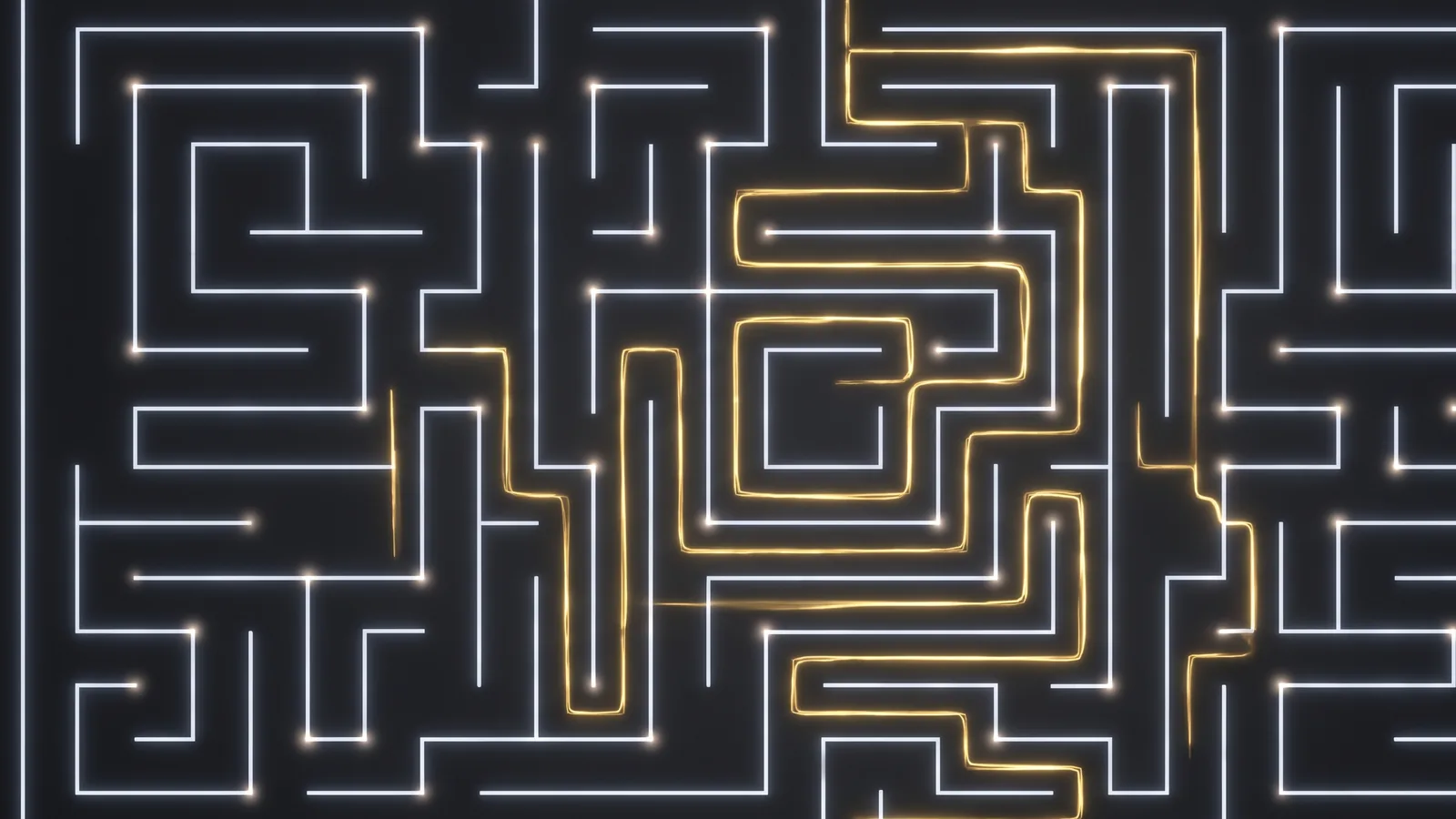
I spent years of my career inside search systems, where every request was secretly the same question: out of all the ways to get there, which one is best? Then I moved to Tokyo, where fourteen million people ask that question of a train network every morning, and I finally understood that the algorithm in this exhibit might be the most-run piece of serious mathematics on Earth. You ran it today. It is in your pocket right now.
- Under every map you have ever used sits a graph: dots and connections, nothing more. The tiles are decoration.
- Below, two famous algorithms race on a maze you draw yourself. One floods outward, patient and blind. One aims.
- The difference between them is a hunch, priced honestly, and the receipt appears after every race.
The Tiles Are Decoration
Strip the streets, the rivers, the pretty labels off any map and what remains is the only part the computer ever sees: dots, connections, and costs. Intersections are dots. Roads are connections. Travel time is the cost of each one. Mathematicians call this a graph, and the reframe is worth saying plainly: your city, your train network, the internet's cables, even the moves of a chess game, all of them collapse into the same object. Whoever can walk a graph cheaply can walk all of them. That is why this one algorithm family carries your commute, your packets, and your parcel deliveries without ever knowing which is which.
The Flood and the Hunch
In 1959, Edsger Dijkstra published the patient answer, an algorithm he later said he worked out in about twenty minutes at a café, without pen or paper. It expands outward from the start like a flood: always extend the cheapest frontier, everywhere, evenly, until the goal is reached. It is provably perfect and completely blind. It does not know where the goal is, so it looks everywhere. Watch it in the race: the blue tide fills the board with no sense of direction, because it has none.
Nine years later, A* added the one thing the flood lacked: a hunch. At every step it asks not only "how far have I come?" but "roughly how far is left?", and it prefers cells where the sum looks promising. The mint-coloured search leans toward the goal like a compass needle. And here is the part that makes it mathematics instead of a mood: as long as the hunch never overestimates the remaining distance, A* is guaranteed to find exactly the same shortest path as the flood, while looking at far less of the board. An honest hunch costs nothing and saves almost everything. The race report under the toy prints the receipt every time. Push the hunch past 1 under the toy and it starts to overestimate; on the Scatter board the receipt shows the price.
Where You Ran It Today
Every time a map app answers before your thumb leaves the screen, a descendant of this pair just walked a graph of millions of nodes. The same family routes packets across the internet backbone, characters through video game levels, and pick-lists through warehouse floors. In my search years the lesson generalised further than I expected: ranking results, planning capacity, routing requests, they are all the same discipline of refusing to examine everything by knowing, honestly, what not to look at. A hunch that never lies is not a shortcut. It is the entire profession, stated politely.
Dijkstra floods; A* aims. The difference is a hunch that has promised never to lie.
Its Place on the Map
On the Cabinet's map this exhibit sits in the Computer Science wedge, pulled toward Mathematics, which is exactly where pathfinding lives: the graph is pure mathematics, the walk through it is pure engineering. It also sits, quietly, underneath the exhibit before it, because a map is a grid, a grid is a graph, and the glider's board was one too. The Cabinet keeps whispering the same sentence: learn one object deeply and half of computing turns out to be that object in costume.
Wall off the whole middle of the board before you go. Leave one gap. Watch the hunch find it.