My first architecture document was rejected in fifteen minutes. I have written about that day already, because it is the day I stopped thinking like an engineer. What took me far longer to understand is the quieter thing my chief architect had that I did not. It was not more knowledge. He could read the same page I had written and see what it looked like from every other chair in the building. I could only see it from mine.
Understanding how the others in the room see it is what makes you more than an architect. It makes you a bridge.
- Perception is the lens you built out of your own wins, failures, and mentors. Perspective is the lens everyone else is already using.
- There is a specific failure that looks like success right up until delivery, and three early signals that you are walking into it.
- Four seats to read every decision from, one sentence rewritten to show the whole difference, and what this discipline earns you over a career.
Perception Is Yours. Perspective Is Everyone Else's.
Clarity is the architect's real tool, and it gets clouded most often by a confusion between two words that sound like synonyms and behave like opposites.
Formed by your own experience: the wins, the failures, the mentors, the hard lessons, and the biases that came free with all of it.
It is genuinely valuable. It is also, unavoidably, subjective. And when it turns out to be misaligned with the situation in front of you, the discipline is to have the courage to adjust it rather than defend it.
How everyone else sees the same decision: their needs, their role, their context, their expectations.
Your customer's problem space. Your team's delivery pressure. Your leader's targets. Your engineer's Tuesday. None of these are visible from your chair, and every one of them changes what the right answer looks like.
The first discipline in this series is about catching your own bias before it becomes a decision, which is work you do on your own perception. This one points outward. It is the harder half, because your perception announces itself and everyone else's perspective has to be gone and fetched.
The Right Design, Built Alone
Picture the design you are proudest of. Resilient, scalable, genuinely correct. Now watch what happens when the room has not travelled with you. The technology holds and the delivery still limps, because a design nobody has bought is a design that gets quietly renegotiated in a hundred small decisions you are not present for.
Every one of those is a communication failure wearing a technical costume. And notice the timing: all three are visible weeks before they cost anything, if you are looking for them. That is the whole opportunity.
Follow the Decision All the Way Down
Detail orientation, done at 360 degrees, means refusing to evaluate a decision only where it is made. Walk it end to end, through design, development, test, deployment, and the monitoring that has to prove it afterwards. Map it against the layers it touches: the infrastructure, the recovery path, the service levels somebody has already promised a customer. Then ask the question that catches most of what a design review misses.
What is the ripple effect of this decision?
Not "does this work", which is the engineer's question and a good one. This one asks who else feels it. A retry policy is a reliability decision at design time, a cost line at the end of the month, a support ticket pattern in quarter three, and an on-call page at three in the morning for a person who was not in this room. Following one decision through all four of those rooms takes about five minutes, and it is the cheapest five minutes in the whole practice.
Read the Room From Every Seat
The practical version of perspective is unglamorous: step out of your architect shoes and listen as though you held someone else's job. Not to be agreeable, but because context lives in conversation and almost never in the document. Each seat at the table is asking a different question, and each one needs a different sentence from you.
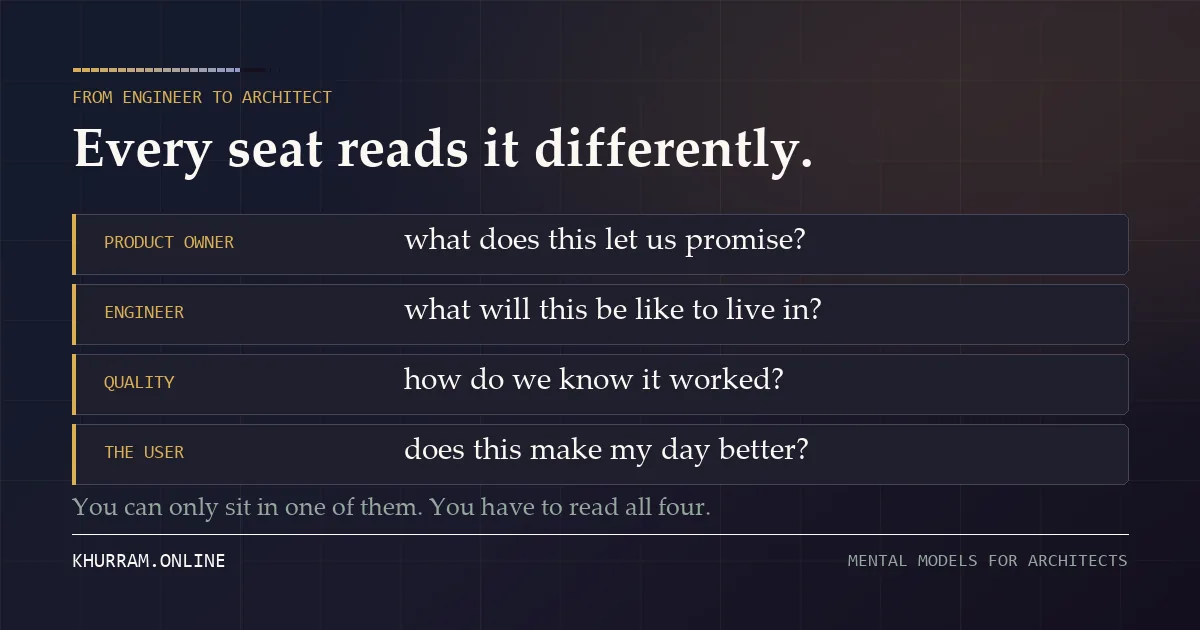
Say the Why, Not Only the What
Most architectural communication fails on economy. We state the conclusion because we already know the reasoning, and the reasoning is the only part the room actually needs. Here is one real sentence, said the way it usually gets said, and then said properly.
"We're using async queues."
Accurate, complete, and impossible to agree or disagree with. It hands the room a fact and keeps the decision to yourself.
"We chose queues over direct calls so the services stop depending on each other being healthy at the same moment, so one slow component cannot cascade into the checkout, and so we can scale the busy part without scaling all of it."
Same decision. Now it is reviewable, and anyone in the room can challenge one clause instead of the whole design.
Two habits protect that second version. The first is to test your assumptions in public: share the trade-offs, the failure scenarios, and the blast radius while the design is still soft, rather than arriving with a finished diagram and inviting applause. Feedback given before you are committed is a gift; feedback given after is a threat to your ego, and everyone in the room knows it.
The second is narrative. An architecture explained as a structure is a list of components. The same architecture explained as a story, with a problem, a constraint, a choice, and a consequence, is something a non-technical stakeholder can carry into a meeting you are not attending and repeat correctly. That is what influence actually is, and it is a feeling-before-formula problem long before it is a diagram problem.
The reveal
Building the full design in private and presenting it complete feels like professionalism. It is usually the most expensive way to work. Every objection you would have heard in week one arrives in week nine instead, when the design has your name welded to it and changing it costs pride as well as time. A design that was argued with early is stronger and cheaper than a design that was admired early.
- Before the meeting, write the one sentence each seat needs. Four sentences, five minutes. It changes the entire shape of the hour that follows.
- Bring the design while it is still soft. Ask for the objection you are most afraid of, by name, and thank the person who gives it to you.
- Say one "so that" out loud for every technical choice. "We chose X so that Y." No "so that" means no shared reason.
- Follow one decision into a room you will not be in. The on-call rota, the invoice, the support queue. Then design for that room too.
What This Discipline Earns You
None of this shows up in a diagram, and all of it shows up in a career. These four compound quietly and then, one day, they are the reason you are in the room.
In high-performing teams, it is not just what you say. It is how well it is understood.
Seeing the decision from every seat tells you what is at stake. It does not yet tell you how to choose. Article 3 turns to the craft of the decision itself: the six tensions real platforms trade, and how to turn "it depends" into something you can defend with evidence.